Parents have a comprehensive responsibility for their children that goes far beyond emotional support and upbringing. One of the central tasks is the financial care of the child, which is regulated by the statutory maintenance obligation. It ensures that children have their basic needs covered - from food and clothing to education.
But many parents ask themselves: how long is this obligation to pay maintenance and how is it calculated? This article takes a detailed look at the legal basis, obligations and rights of parents and provides practical tips on long-term financial security for children.


Parents care for their children - don't view maintenance primarily as a legal issue
Maintenance is much more than a legal obligation - it forms the basis for your child's future and quality of life. In addition to the financial aspect, which describes the cash maintenance that is used for food, clothing or school costs, for example, the so-called maintenance in kind plays a decisive role. This includes loving care, upbringing and nurturing, which have a significant influence on the child's well-being.
Parents therefore have a double responsibility: both emotionally and financially. A children's savings plan can be a valuable way of saving money and building up reserves for later education, thus ensuring long-term financial security even after a separation or divorce.
The best for your child: invest today, benefit tomorrow.
Legal basis of the maintenance obligation
The obligation to provide maintenance for children and relatives is enshrined in family law and the German Civil Code (§§ 1601 ff BGB) and obliges parents to ensure their child's livelihood. This includes basic needs within reasonable limits and an education to provide the child with a stable foundation for its future.
The amount of maintenance is based on the individual needs of the child and the financial means of the parents in whose household the child lives. A balance is always sought between the needs of the offspring and the ability of the person liable to pay maintenance.
In cases of dispute or if the amount of maintenance is unclear, lawyers or special maintenance calculators can be helpful in finding a fair and legally compliant solution and protecting the interests of all parties involved. In the worst-case scenario, a maintenance debtor could face compulsory enforcement.
Start and duration of the maintenance obligation
The maintenance obligation begins with the birth of the child and is not tied to a fixed age limit. Instead, the duration of the obligation depends, for example, on the individual circumstances of the child and the financial circumstances of the debtor:
- Ability to pay of the debtor: If the debtor is financially unable to pay the minimum maintenance, the obligation is waived in whole or in part. The ability to pay is assessed on an individual basis and an application can be made for an advance on maintenance payments.
- First vocational training: The entitlement to maintenance generally remains in place until the child has completed their first vocational training, be it an apprenticeship or a course of study, whereby a training allowance can be offset.
- Further education: A maintenance obligation may also exist beyond this, provided that the training is sensibly planned and builds on each other, for example in the case of a subsequent Master's degree.
Düsseldorf table - calculation of child maintenance
The calculation of maintenance amounts is a complex process that depends on several factors, including the parents' income, standard of living and the child's individual need. The Düsseldorfer table provides a central guide.
It determines the child's maintenance requirements depending on the income of the parent liable for maintenance and the age of the child, so that interested parties can create sample calculations. However, this is not a rigid rule, but a guideline that can be adapted depending on the individual case.
A decisive aspect is the financial capacity of the spouse who is obliged to pay maintenance. The so-called deductible protects their minimum subsistence level and guarantees that sufficient funds remain for their own living expenses.
At the same time, the statutory minimum maintenance regulation, which is adjusted annually, ensures that the rising cost of living is taken into account in maintenance payments. This ensures a fair balance between the needs of the child and the means of the debtor.
Child benefit and its deduction from maintenance
Child benefit plays an important role in the calculation of maintenance and is offset against the child's needs. In the case of underage children, half of the child benefit is generally taken into account, while it is taken into account in full for adult children.
This means that the parent liable for maintenance must pay a correspondingly reduced amount, which offsets the financial burden somewhat.
Maintenance when the child comes of age
As things stand today, adult children are also entitled to maintenance as long as they are in their first vocational training, regardless of whether they are studying or doing an apprenticeship.
Parents are legally obliged to provide up to €990 per month on average (as of 2025) per dependent, which in some cases means that they have to reduce their own expenses in order to meet this obligation.
Special needs and additional needs of the child
In addition to regular maintenance, there are extraordinary costs that can be claimed as special needs in the maintenance obligation. These include one-off, unforeseen expenses such as school trips, medical treatment or necessary therapies.
There may also be additional needs that arise on a regular basis, for example for study costs, extra tuition or special support measures. These additional obligations extend the parents' maintenance obligation and often require a precise agreement in order to fully cover the child's financial needs.
Deductible and maintenance obligation
The maintenance debtor's deductible ensures that their own needs and thus their minimum subsistence level remain protected and that they can cover their own living expenses. The current amounts are
- 1,450 euros for employed persons
- 1,200 euros for people not in gainful employment
Parents with a high income have a correspondingly adjusted, higher deductible. This regulation enables a fair distribution of financial obligations without overburdening the person liable for maintenance or disadvantaging the child.
Reform of maintenance law - current developments
Maintenance law is an issue that is constantly changing to reflect the changing realities of modern family life. Reforms are aimed at making the legal regulations clearer and fairer, especially for complex family constellations such as patchwork families or alternating models in which children live alternately with both parents.
One of the challenges is to distribute maintenance obligations fairly so that both parents contribute appropriately to the care of the child. At the same time, reforms should reduce conflicts between separated parents and focus on the child's welfare. New approaches also take into account flexible working models and the changing roles of mothers and fathers in society.

How can I secure long-term support for my children?
Investing early is the key to your child's financial security. With thoughtful planning, you can not only secure your child's financial future, but also ensure that they can realize their dreams. However, not all forms of investment are equally beneficial.
- Savings accounts: Nowadays, these only offer a minimal interest gain, which means that they can barely keep up with inflation. The lack of growth potential makes them unattractive in the long term.
- Home loan and savings contracts: High acquisition and administration costs as well as rigid conditions make flexibility difficult. They are rarely worthwhile, especially when short-term financial flexibility is important.
- Fixed-term deposit accounts: Although secure, they have fixed terms and hardly any potential returns, making them unsuitable for long-term wealth accumulation.
- Share portfolio: A share portfolio for children offers potential for high returns, but requires extensive market knowledge. High fees, tax charges and market risks often make this option problematic for inexperienced investors.
- Precious metals: Gold and other precious metals are considered safe, but do not generate regular returns and are subject to strong price fluctuations.
- Real estate funds: These require high entry sums and offer uncertain returns, which makes them unattractive for many parents.
- Life insurance: Traditional models are often expensive and offer low returns compared to modern products.
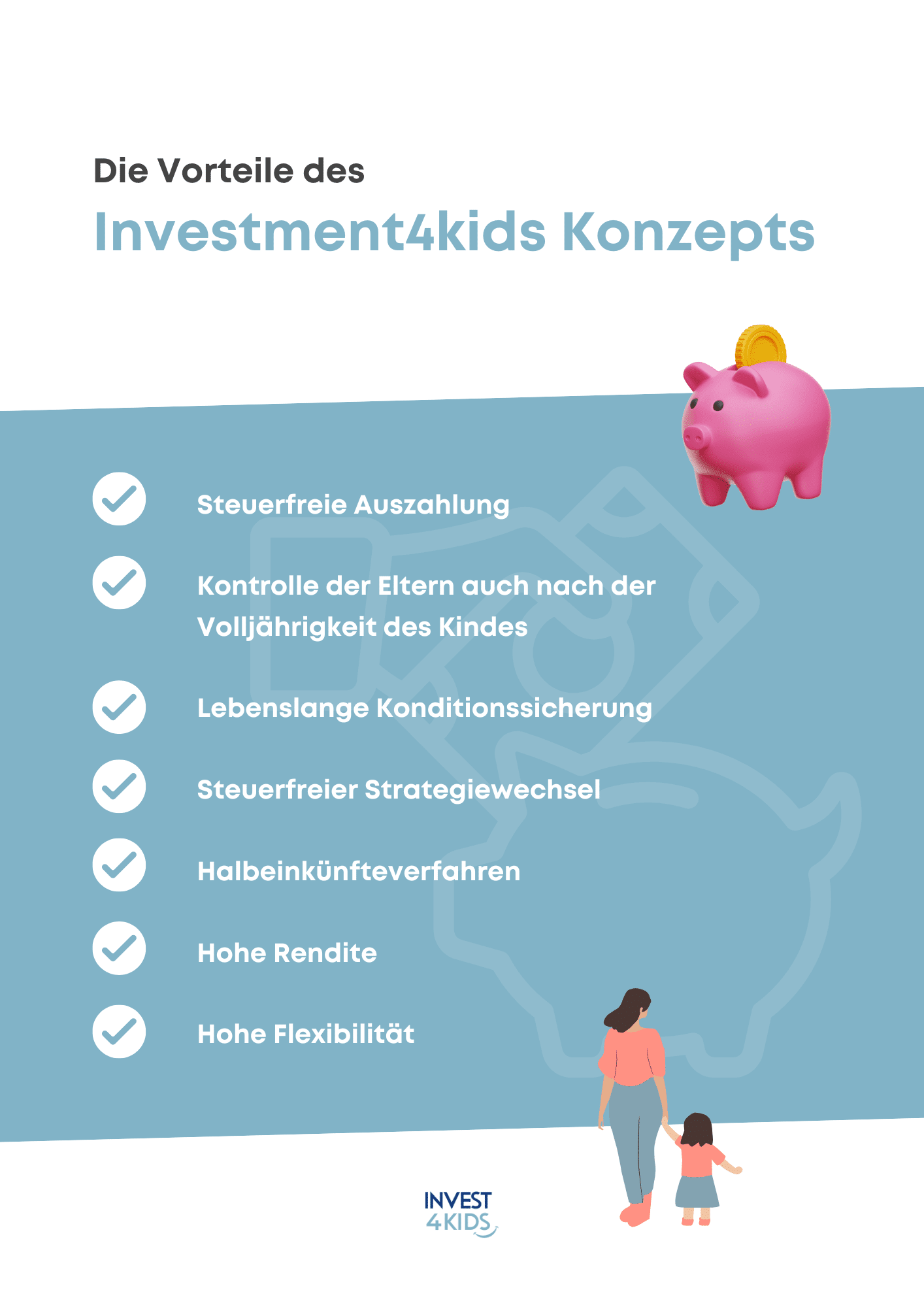
- ETF pension insurance: In contrast, ETF pension insurance offers tax advantages, flexibility and planning security. Income can be reinvested tax-free and additional insurance cover provides long-term security. This option combines growth with stability and is ideally suited to the individual needs of parents and children.
Conclusion
Child support is a fundamental responsibility that parents should take great care to fulfill. It ensures that the child's living expenses are covered, from basic necessities such as food and clothing to education and training.
The amount of maintenance payments is determined by various factors, including the parents' income, standard of living and the child's individual needs. Long-term security for child maintenance can be achieved through smart financial planning and early investment.
ETF pension insurance in particular offers clear advantages here: it combines tax benefits, high flexibility and long-term growth opportunities. Income can be reinvested tax-free, while integrated insurance cover provides additional security. This solution enables parents not only to secure their children's financial future, but also to fulfill wishes such as studying or spending time abroad.
Request free advice and information on building up your child's assets and set the course for tomorrow today!